What is an MCI? An incident with more patients than resources (emergency responders). The objective for emergency responders in an MCI is to save the most lives possible. There is no "one size fits all" answer for determining an MCI. By declaring an MCI you are attempting to set your priorities quickly. The priorities are based on the number of patients, the severity of patients, the type of incident, and resources available. Methods and techniques assist emergency responders in saving the most lives possible and maybe adjusted to fit the incident.
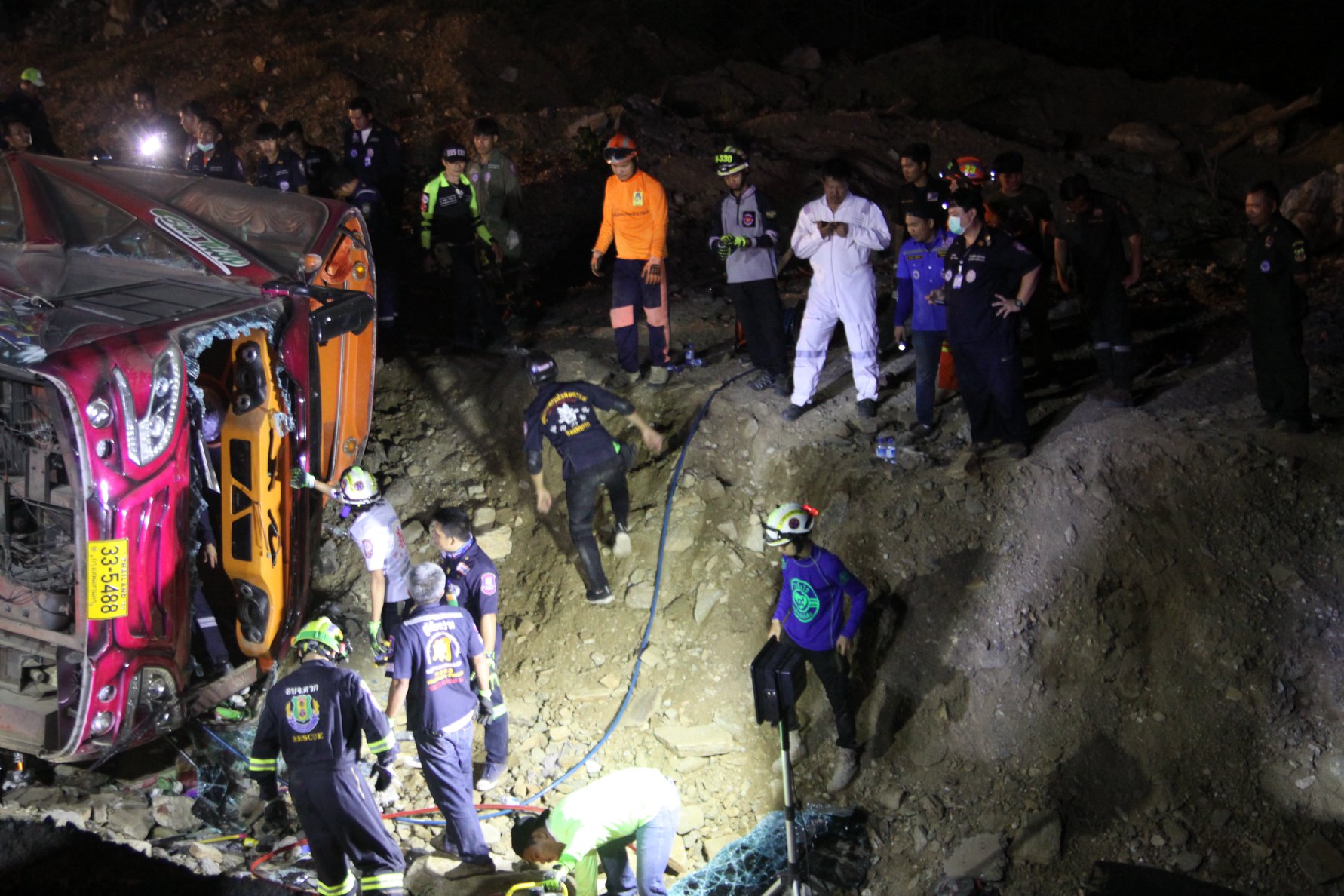
An MCI can often be broken into 3 stages;
Triage → Treatment → Transport
Triage
What does the 1st vehicle on scene need to do?
Scene size-up, scene safety, then triage; when the unit arrives on scene they still give an initial size-up the way they would for any other incident, account for scene safety as they approach the scene the same as they would for other scenes. A major difference is in the patient assessment using triage methods instead of assessing a single patient. Triage generally is the job of the first arriving unit.
For example; when arriving at a bus wreck, the team leader gives a radio size-up, 1-2 team members block traffic from the scene (the beginning of scene safety), next 2 team members will begin patient triage.
The triage unit/team only:
- assesses patients
- opens airways
- blocks major bleeds
The triage unit WILL NOT:
- do CPR
- sit holding C-spine
- do jaw thrust
How do you open airways? Even though the incident may be a trauma incident, we use the head-tilt chin lift method.
Pre-hospital triaging methods categorize patients in 4 levels:
| Level | Color | Condition | |
|---|---|---|---|
| Priority 1 Immediate | Red | Life threatening | |
| Priority 2 Delayed | Yellow | Not life threatening yet but could be soon | |
| Priority 3 Minor | Green | Not life threatening | |
| Priority 0 Expectant/Deceased | Black | Requires either palliative care or body removal |
START Triage Method
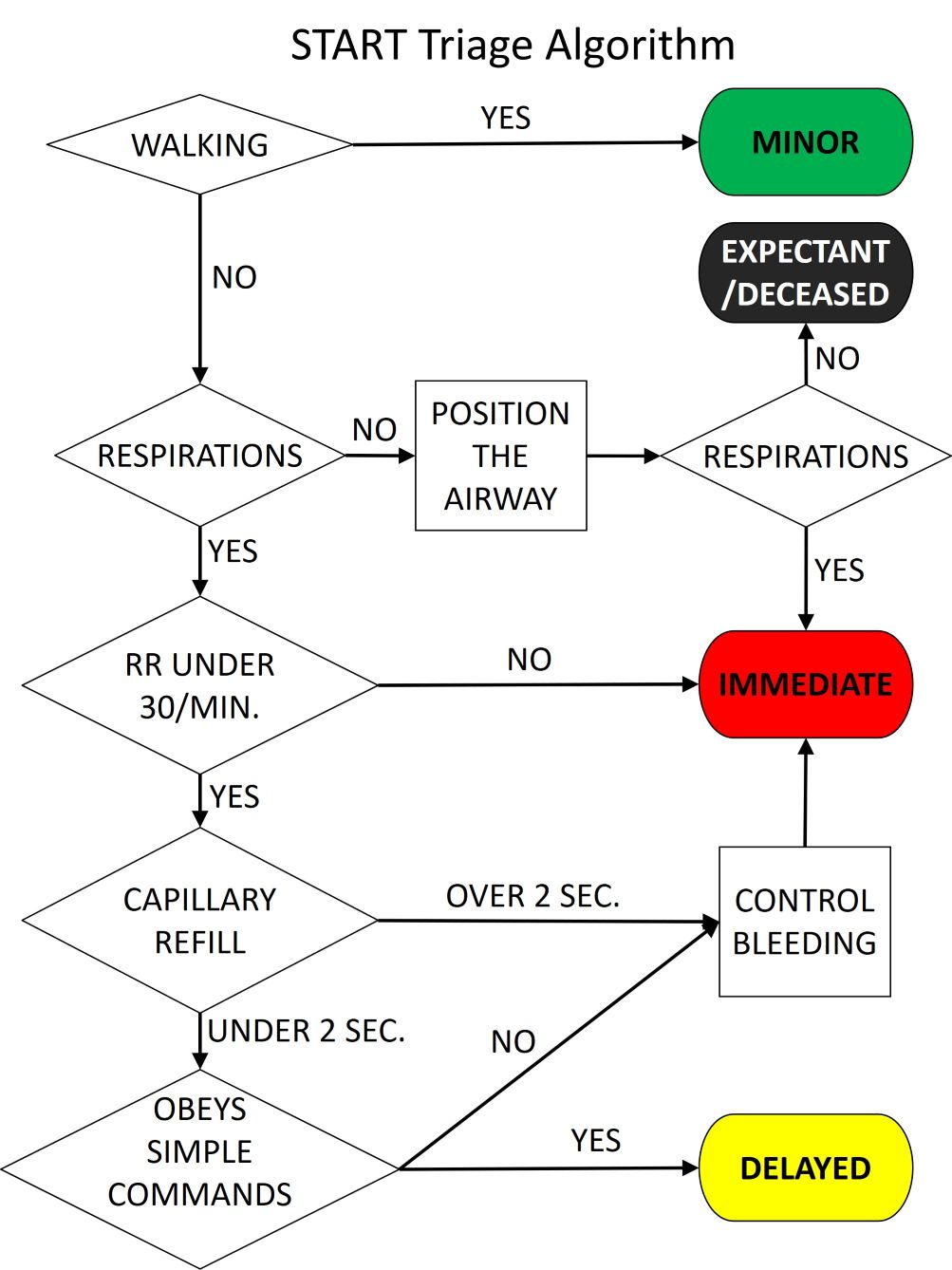
In English the phrase "30 and 2, Can do" helps with remembering how to assess patients using the START triage method.
If patients are not breathing, then rescuers open the airway. After opening the airway if the patient does not breath, they are marked deceased. If patients can walk and understand, they are minor. If patients are breathing, but breathing is greater than 30 respirations per minute they are immediate. If patients have a capillary refill time greater than 2 seconds, they are immediate. If patients can not follow simple commands, they are immediate. All non-walking patients that can follow simple commands, have normal breathing, and good circulation, are delayed. There are exceptions in how patients should be categorized, but this is a basic outline of how to do triage.
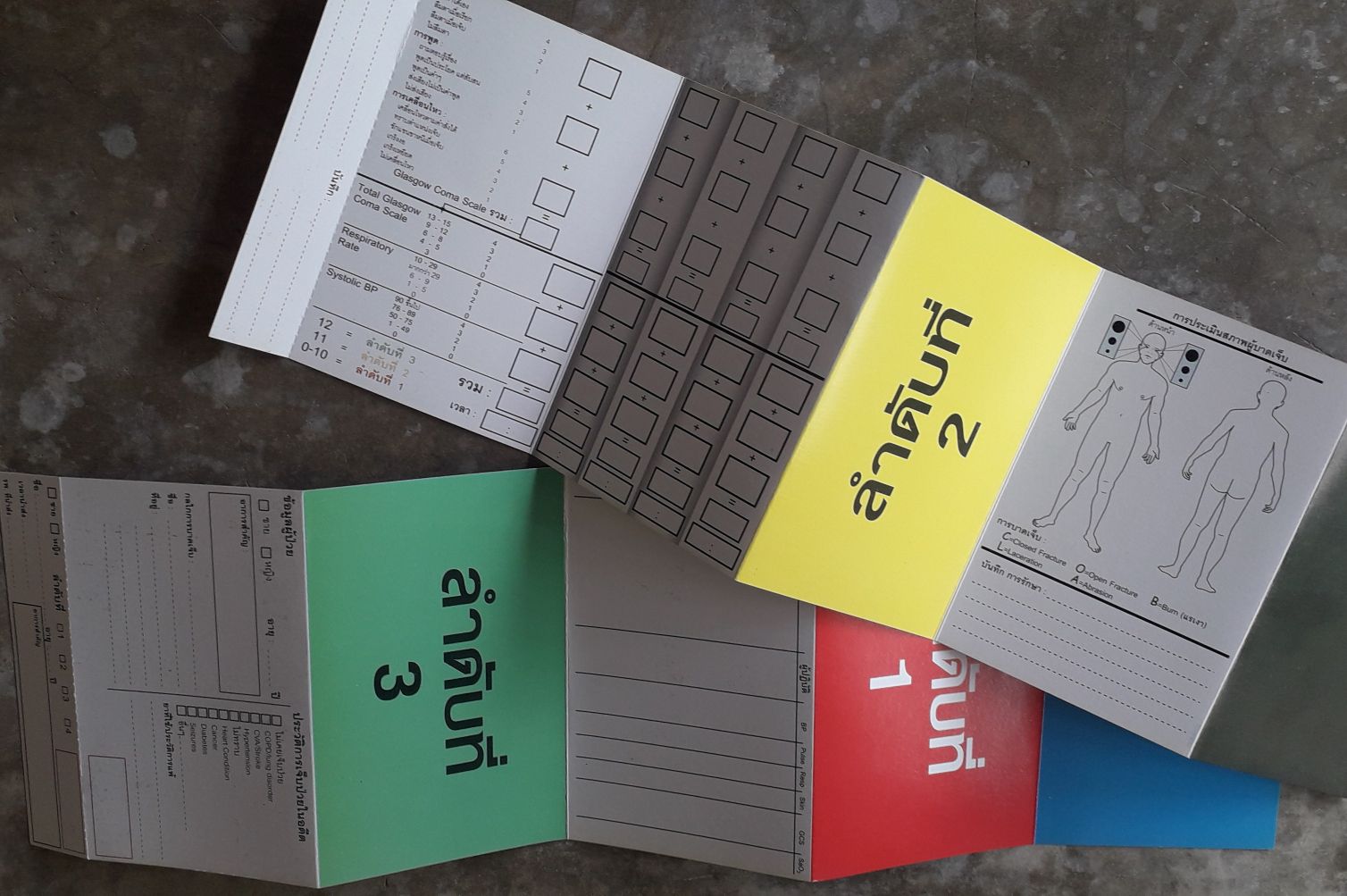
How can we mark patients as we triage them? Tags, tape, markers, are all different methods that can be used. There is no 100% right answer for what will always work, the point is to have a method available that is clearly visible to other emergency responders and does not cause more harm to the patient.
What about children? Currently the JumpSTART method for triaging children is encouraged to be used in the place of the START method. JumpSTART method separates children into 3 categories generally based on height. There are triage tapes available with flow chart instructions on how triage a pediatric patient. The tape is set next to the patient's head and the corresponding instructions are at the patient's feet. If we do not have a JumpSTART triage tape available, we can try to remember these main differences:
- If the child is not breathing open the airway → if the child still does not breath → give 5 rescue breaths
- An acceptable pediatric RR 15 – 45 / min.
- Check for any appropriate verbal or painful response → if response is not correct or the child is posturing then red → any appropriate verbal or painful response for a child is yellow
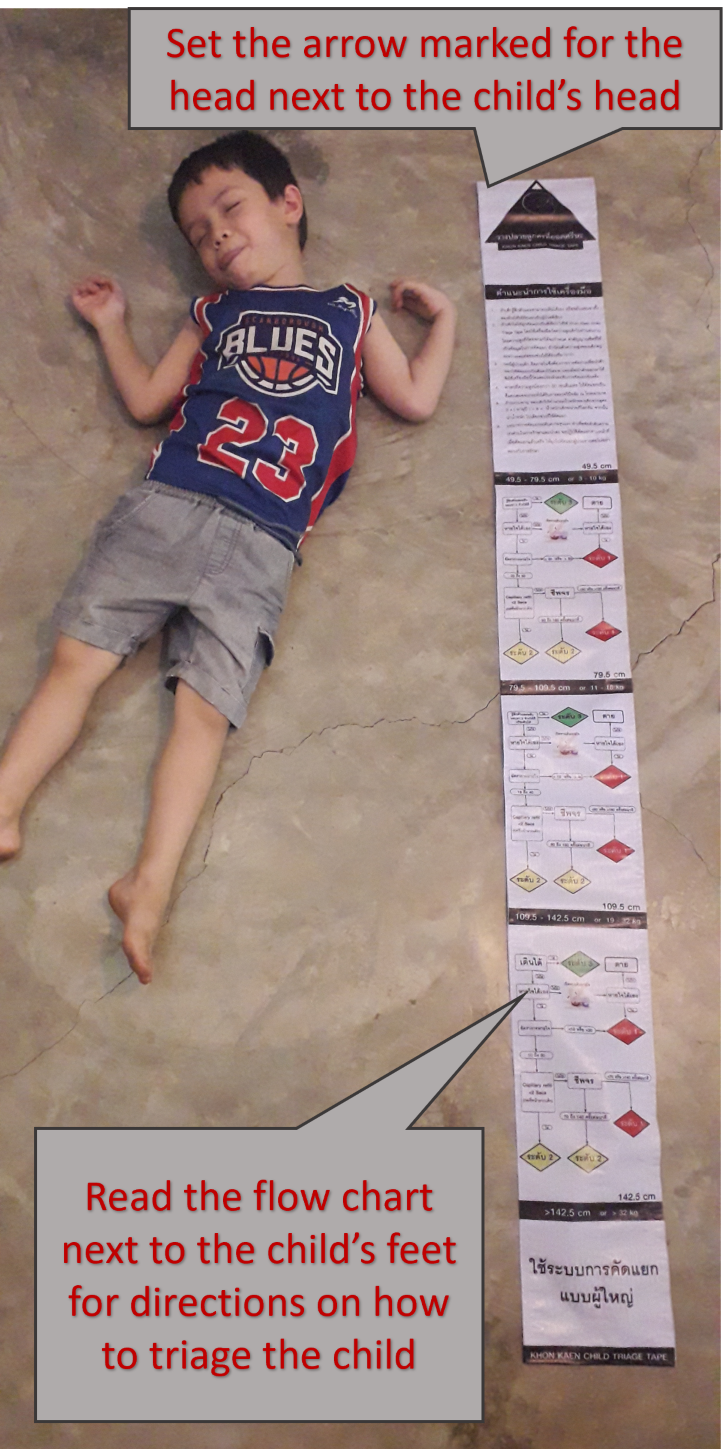
You can download a printable copy of the JumpSTART Triage Tape here. Just do not adjust the dimensions when printing or it will change how the tape works.

Treatment Considerations
Once you have figured out who to treat 1st, assign people to treat the patients. As more responders arrive, assign them to the next patients in the queue or where needed at the incident. Organizing work areas depends on the situation, possibly removing patients from the hazard area to a treatment area, such as in a hazardous materials incident or a terrorist attack. Vehicle accidents often can load the patients directly into the ambulances without the need for a separate treatment area.
When assigned to a patient, emergency responders would now apply the appropriate interventions; C-collar, backboard, airways, etc. and do a complete patient assessment. As there may be a multitude of patients, some interventions may be simplified, such as using the backboard as the primary splinting option without applying more detailed splint options.
If triage tags are being used, my personal experience is that these are used as the patient report form that is delivered to the hospital. After we were released from the incident we completed our regular patient reports back at the station (if you do not use e-forms this might not be possible). This way documentation was completed but it does not hinder patient treatment.
Transport considerations
How do ambulances get in and out?
How do patients get in ambulances?
Reds usually require a lot of attention and will often be 1 patient to 1 ambulance.
Can you put 2 yellows in 1 ambulance?
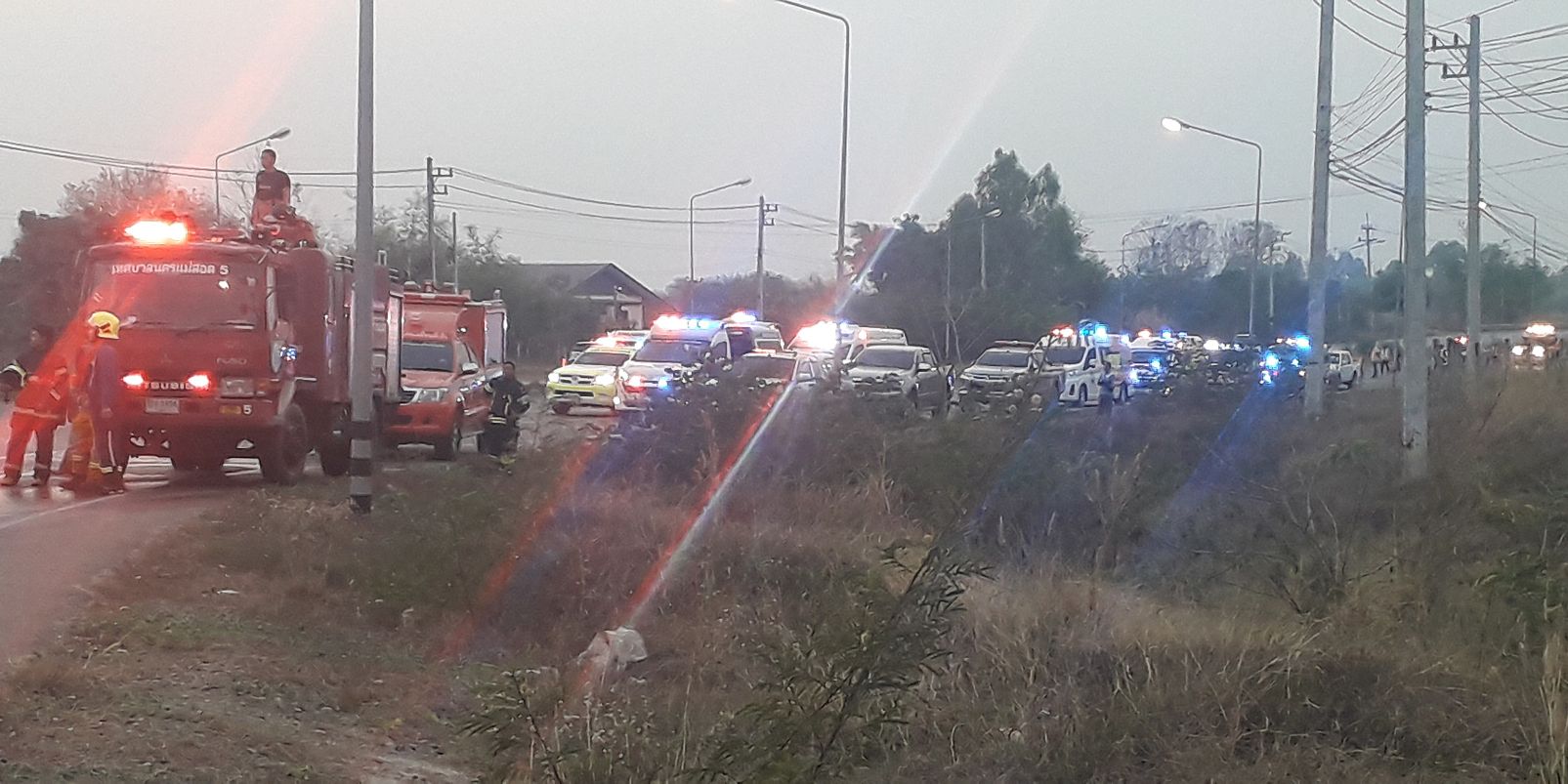
Can you get a bus or van to transport greens? Make sure to put emergency responders with supplies in the vehicle with the greens to continue assessment and treatment. The driver for green patients should double check which hospital to go to as the primary hospital maybe on deferment.
As the 1st vehicle on scene, what do you use radios for? Tell incoming emergency responders where to go/park; i.e. staging. For detailed information, talk face-to-face, giving assignments. The team leader/IC should meet incoming units and give assignments. As the situation gets larger, the IC may assign a staging officer to meet incoming units.
What do you do when you arrive as a 3rd or 4th unit on scene? Ask for the IC or staging officer, tell your unit and how many emergency responders you have, and ask for an assignment.
As the 1st vehicle on scene, when a higher authority takes charge, how do you hand over the scene? Similar to a size-up, give what is involved, what went wrong/not normal, what are the hazards, what units are on the scene, where the units are and what they are doing. Ask for a new assignment.
The Incident Command System (ICS) becomes important for large incidents, but ICS is another topic for another article.
Thank you Chaiwat Maneematcha and Natthawut Kititee for help with the photos.
References:
Illinois Emergency Medical Services for Children. (2016). Pediatric Disaster Triage Training Scenarios: Utilizing the JumpSTART Method. Springfield, IL: Illinois Department of Public Health.
Kanchanasut, D. S. (2017). Out-of-Hospital Emergency Operations Manual for All Levels. Bangkok: National Institute of Emergency Medicine.
Tarantino, C. (n.d.). Disaster Triage Train-the-Trainer START & JumpSTART. Rochester, NY: University of Rochester Medical Center.