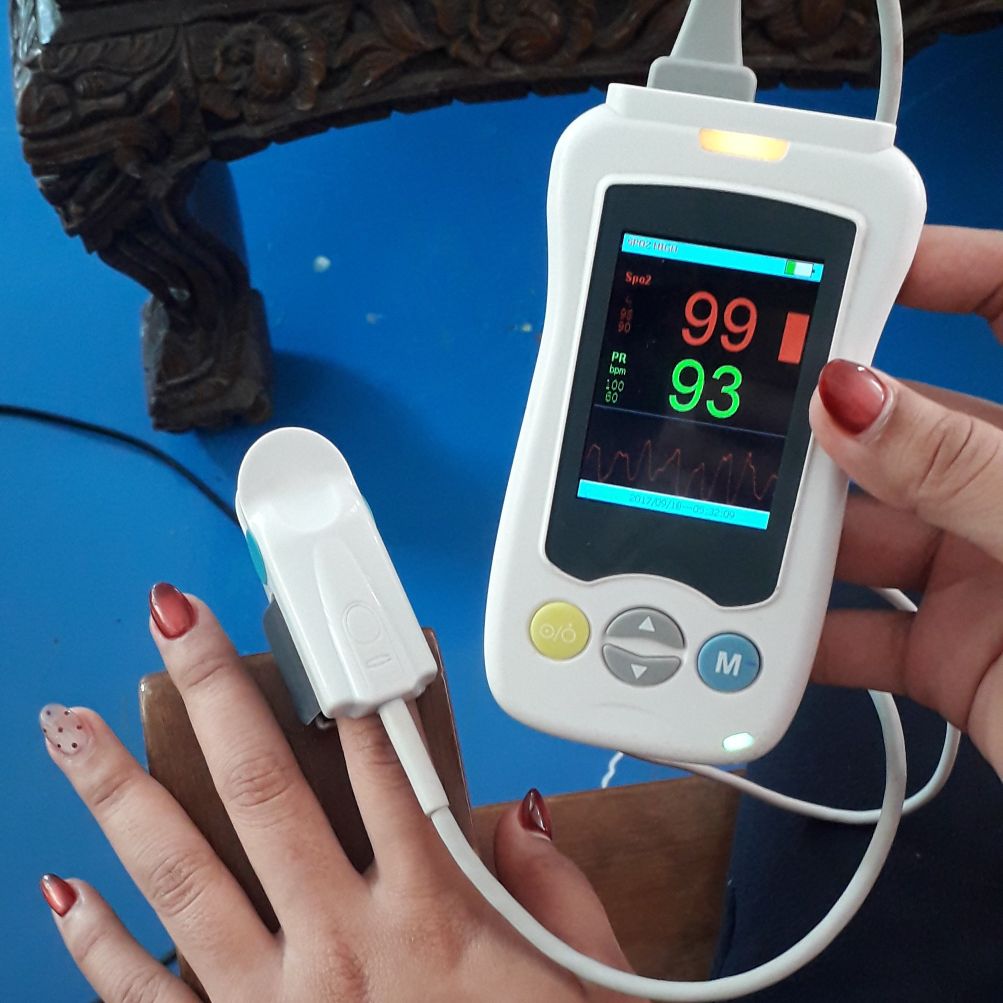
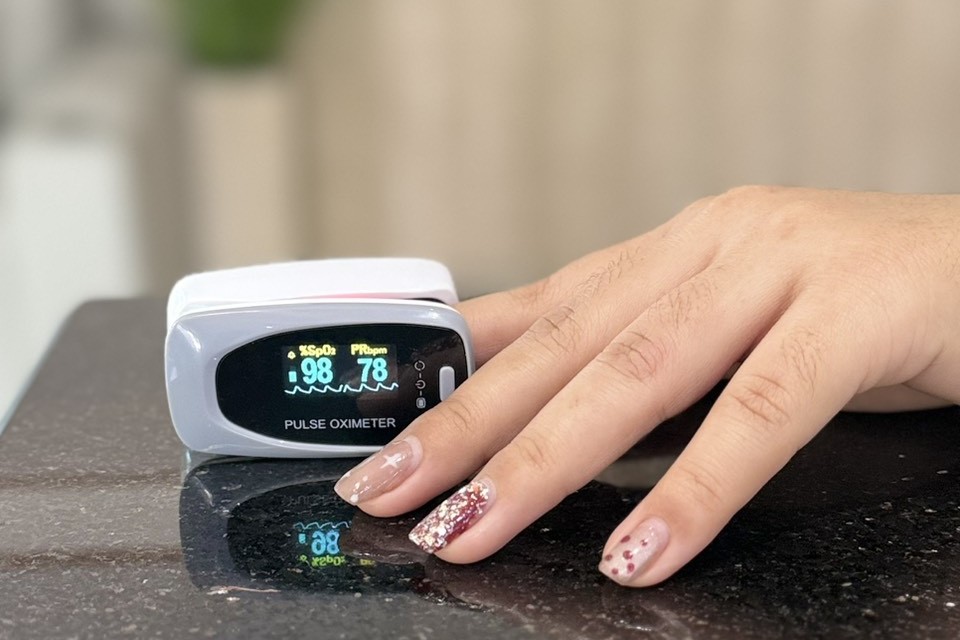
For pulse oximetry we measure the percentage of oxygen saturation of the red blood cells or the estimated O2 molecules delivered throughout the body. To measure this we use specific devices, called pulse oximeters, that shoot light through a body part, usually a finger, and measure how much infrared light has been absorbed. We turn the pulse oximeter on and place it on a finger clean of blood and dirt, otherwise the blood and dirt may block our reading. If the patient has fancy false nails or nail polish turn the pulse oximeter sideways to read through human flesh, not the acrylic paint (the photo above has short nails while the photo below has long nails). While the meter starts to give a number within seconds, we should read the number on the meter after a full minute before recording the pulse oximetry percentage.
Beware that if something, such as cold, affects circulation to the extremities (the patient’s arms and legs) the meter may not be able to get a proper reading. Certain drugs such as staining dilution drugs (for example methylene blue) may cause inaccurate readings. Also, if the patient has carbon monoxide (CO) poisoning the meter will read both the CO and O2 in the blood as the same, thus giving a false reading.
Some patients who smoke regularly often have bodies that have adjusted to a lower oxygen percentage than what we consider normal. Also, remember that while CO2 levels trigger involuntary breathing in normal healthy people, certain COPD patients may have involuntary breathing regulated by O2 levels, meaning carefully consider what will happen if we give oxygen to a patient with a low O2 percentage. Please remember to assess the patient, not the meter.
Common assessments of pulse oximetry percentages should be;
| Assumed Patient Situation | Percentage of Oxygen |
|---|---|
| Normal | 95-100 |
| Concerning | 91-95 |
| Low Oxygen | 85-90 |
| Adverse Effects | 68-84 |
| Cyanosis | 67 or less |
Please be aware that the current market offers many cheap pulse oximeter devices, often faulty oximeters. When purchasing equipment consider the reliability of a device. When starting a work shift, check your equipment to make sure it works properly.
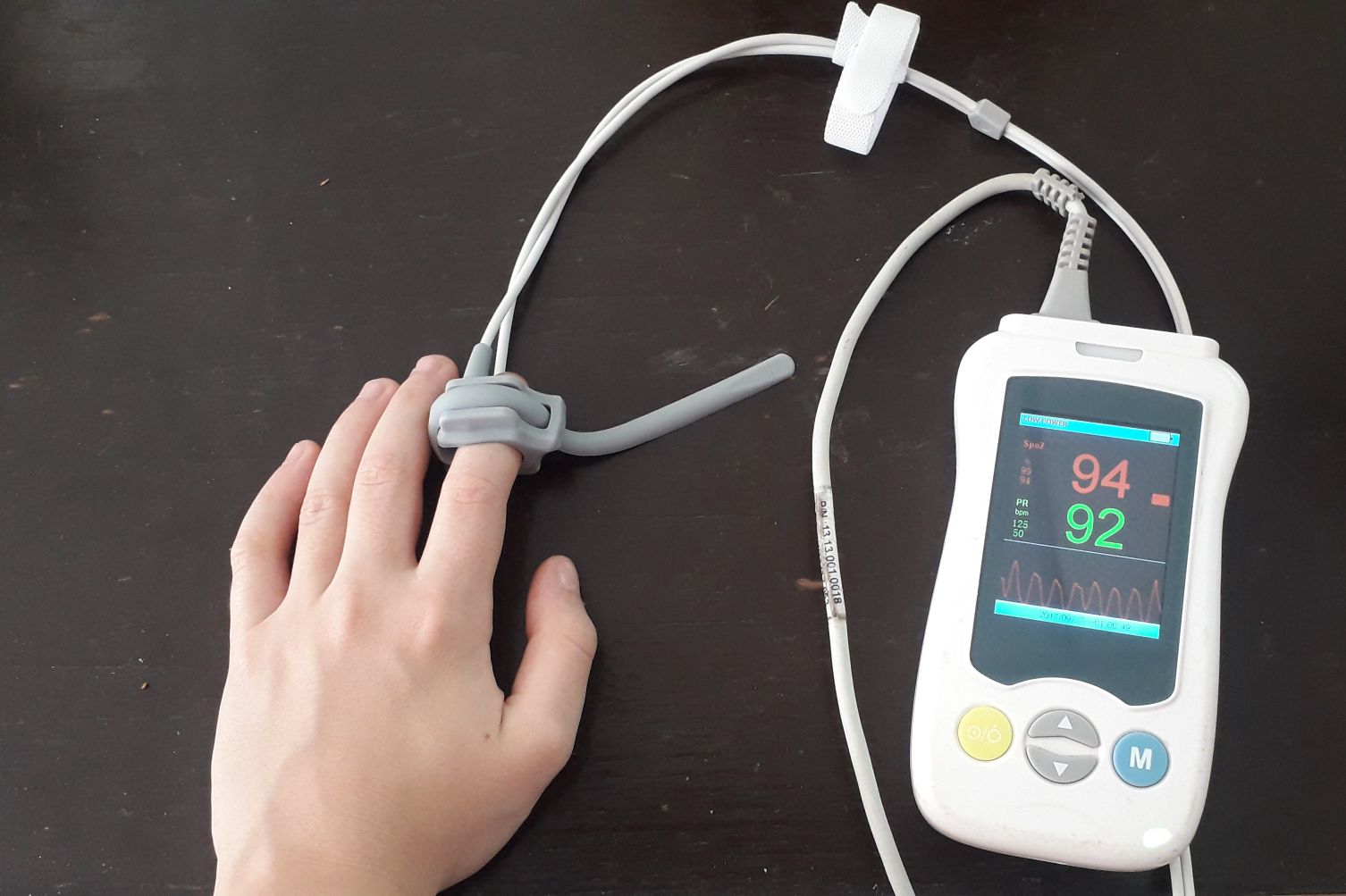
Thank you to Pitakkarn Rescue for help with the photographs. Being a hero usually takes teamwork.
References
Cleveland Clinic. (2023, March 15). Vital Signs. Retrieved from Cleveland Clinic: my.clevelandclinic.org/health/articles/10881-vital-signs
Contec Medical Systems Co., Ltd. (2019, November). Pulse Oximeter CMS50D2 User Manual. Qinhuangdao: Contec Medical Systems Co., Ltd.
Drake, H. (2022, January 14). Pulse Oximeter Chart Safe Normal Low Blood Oxygen Levels. Retrieved from Nurse Focus: nursefocus.net/pulse-oximeter-chart-safe-normal-low-blood-oxygen-levels/
Limmer, D. O. (2007). Emergency Care 10th Ed. Upper Saddle River, New Jersey: Pearson Education Inc.
Rakhimov, A. (2020, September 10). CO2 Breath Control (Regulation of Respiration): O2 vs. CO2. Retrieved from Normal Breathing: https://www.normalbreathing.com/co2-breath-control/
Sapra A, M. A. (2023, May 1). Vital Sign Assessment. StatPearls.