Incident Command System (ICS) provides standardized management methods and processes for all units, agencies, and organizations responding to an emergency incident. This way people unfamiliar with each other can effectively work together toward common goals at an incident. We will look at how the Incident Command System organization structure allows leaders at emergency incidents to better manage the chaos of an emergency scene. Yes, ICS can be used to manage planned events as well, the main focus in this article is emergencies.
Modular Organization
Always remember that the ICS organization structure is modular. Think of child playing with building with blocks, if child wants a tower, stack blocks up to make the tower, or if the child needs a stair case, arrange the blocks as steps. You will not need to fill every spot in the organization chart for most incidents. Remember ICS is about managing the resources you need to get the job done.
Basic Structure
What is the organization structure for ICS? ICS has 4-5 Functional Areas; Command, Operations, Planning, Logistics, Finance/Administration (for Thailand Finance/Administration is split with finance being a branch in the Logistics section and administration a function of the Planning section). Every incident will have the Operations section of things that gets the job done; saving babies, rescuing damsels in distress, helping old ladies, whatever being the hero is. Every incident should have Command area as well, the person taking responsibility for the situation. The other 2-3 areas, Planning, Logistics, and Finance/Admin, are only added when the incident is large enough that these units need to be added on.
What is “large enough”? Every organization should have its own supply room that serves as logistics for the day-to-day incidents. Every organization should have its own annual and monthly budget that serves as finance for the day-to-day incidents. Again, every organization should have a duty roster or shift schedule that serves as the planning for the day-to-day incidents. When the incident is so big that it has to be separated from the day-to-day operations, that is when you possibly need planning, logistics, and/or finance sections.
We can use the terms Command staff for people working in the Command section and General staff for people managing the Operations, Planning, Logistics, and Finance/Admin Sections.
Click on a part of the ICS organization chart to learn more
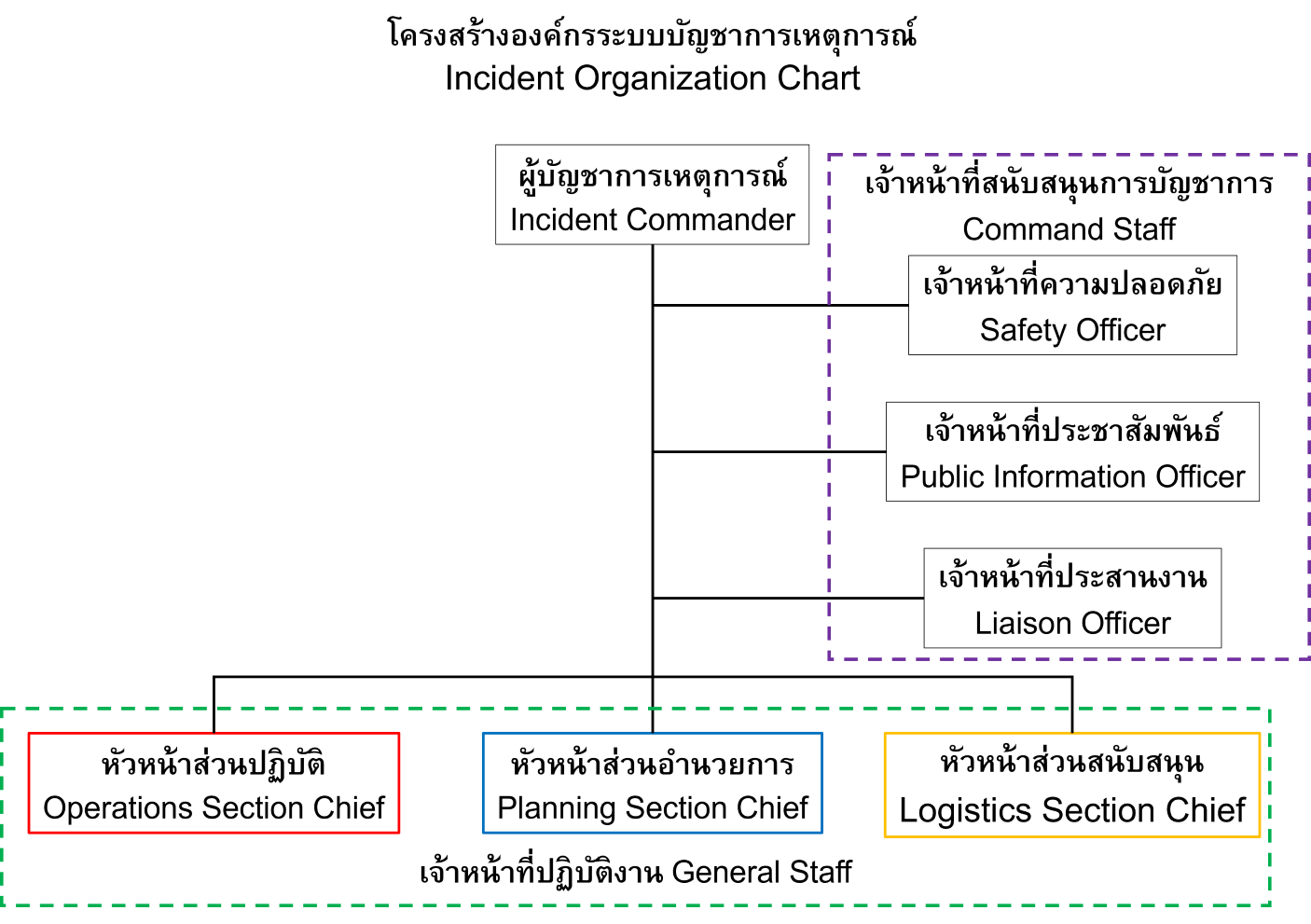
Command Staff
Command Staff are considered mostly “consulting” roles, but do not think of this as extra fluff. Think of the command staff as experts in media, marketing, industrial hygiene, international affairs, and social science. Neither the emergency responders or the IC have time to learn these college level skills in 12 hours, so they call the experts.
General Staff
Who figures out how victims will be rescued? Who figures out where food for disaster survivors will come from? Who figures out the details of an incident response? The IC gives the overall objectives for an incident, the General Staff figure out the tactics, methods, and means by which the objectives will be accomplished.
Summary
Incident Command System should be viewed as a tool to help leadership manage an incident. Remember we use the tool, not the tool uses us. Assign the positions in ICS organization that your incident needs, not positions you do not need. Tools can help us to do great work but if we do not use the tools correctly is does not matter how good the tool is. ICS can help us manage incidents, but our leadership skills will define how we will use ICS.
References
ศิริสาคร พงศธร บรรณาธิการ (กันยายน 2559) ระบบบัญชาการเหตุการณ์กับการจัดการในภาวะฉุกเฉินของประเทศไทย กรุงเทพมหานคร กรมป้องกันและบรรเทาสาธารณภัย
Emergency Management Institute. (2018, June 25). ICS 100, Introduction to the Incident Command System. Emmitsburg, MD: Federal Emergency Management Agency.
FEMA Disaster Operations Directorate. (2010). FEMA Incident Management Handbook. Washington, D.C.: Federal Emergency Managment Agency.