We need to talk about teamwork in water rescue. Understanding teamwork in a water rescue will help us recognize priorities and adapt to the emergency situation.
Assumptions
When writing this I am making a couple of assumptions;
- Friends and family in the vicinity when an incident starts, will be first on scene, and therefore will start attempting a rescue from the initial site of the incident. Emergency responders called to the scene will be responding with vehicles at least several minutes into the incident. Therefore, it is helpful for friends and family to understand some basics about water safety and how to begin rescue preparations.
- Whether we are right at the scene when the incident starts, or being called to a scene, accomplishing rescue often involves multiple people working together as a team to do different tasks at the same time.
Rescue Priorities
Priorities of water rescue should generally be the same as any other type of rescue.
Myself → my team (other rescuers) → public/by-standers → victims/patients → property
This means that all priorities will receive attention at some point, not that the only priority we ever care about is ourselves. Just the same as our priorities in our daily living need to be balanced, our priorities at an emergency need to be balanced. The reason myself is first, if we become a victim we are adding to the rescue not helping.
Water Rescue Teams
Most successful saves of drowning victims will be by the people right on scene the moment when the drowning starts. If we are on scene at the time a person gets into trouble, we need to:
- Call for help
- Start by using simple quick rescue techniques
- Work together with the people nearby
- And designate a leader
To work together with the people around us at the moment of a water emergency we should be aware of our surroundings (please check out the articles about scene size-up and water hazards for awareness) and we should be able to quickly put together a plan of how to work together (please check out the previous article on decision making in emergency service).
How should we organize our group of rescuers to save people at a water incident?
Water is dynamic and in a water emergency, we should first spread our rescuers out to account for a changing scene. For the family or friends immediately at the scene when it happens, they most likely will be right near the victim(s) and possibly start attempting to rescue the victim(s). It is suggested, one of the on-scene family and friends step up as the leader and identify the need to spread people out in rescue teams. The commonly way of organizing river teams is into upstream spotter team, rescue team, and downstream safety team. Emergency responders, will approach the scene from the outside and often send people upstream first to stabilize the situation. The arriving emergency unit leader and the onsite leader should attempt to link up and share information about the situation (transfer of command).
If initial onsite responders and later arriving swift water rescue teams have different approaches, neither approach is wrong but reflects different timing and resources. Emergency responders often rescue distressed persons, while on-scene family and friends often have the greatest opportunity to rescue drowning victims. Regardless of what stage the rescue is in when we arrive, we collaborate with others on scene to save the victim(s).
How can you use effective and compassionate communication to work together with other rescuers?
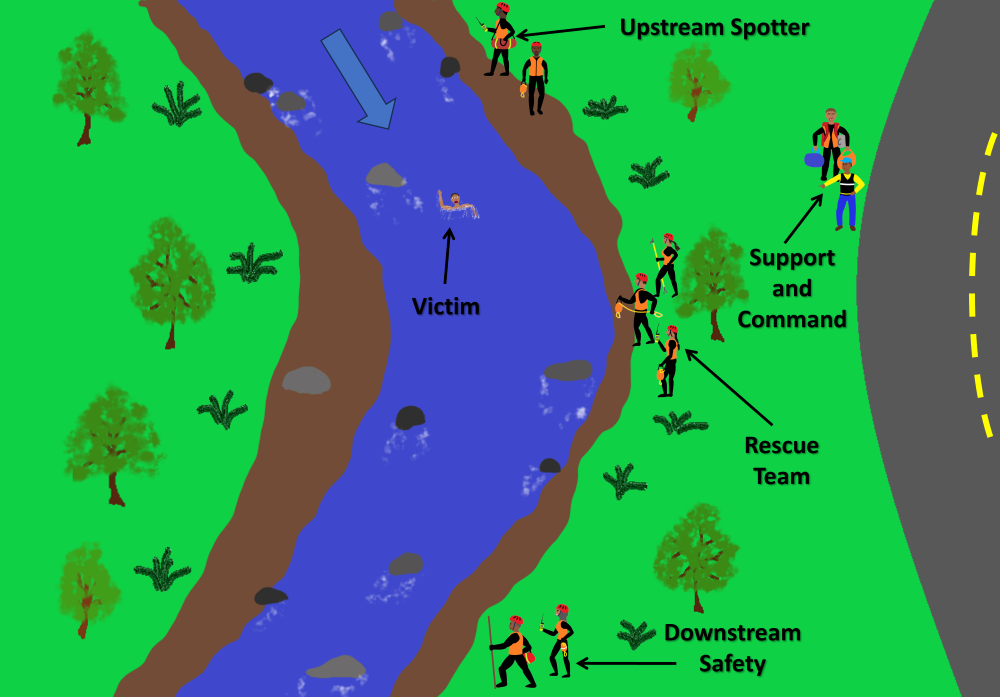
The basic break down of water rescue teams is as follows;
|
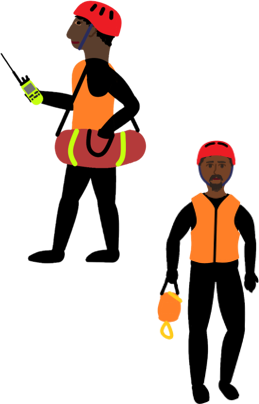
Upstream Spotter – At least one rescuer should be able to see further upstream and still be able to quickly communicate any incoming hazards to the rescue team downstream. Consider the upstream spotter also like traffic control at an accident scene, but instead of waving cars around an accident, they should be warning people coming down river to get out and not foul up the rescue scene. |
|
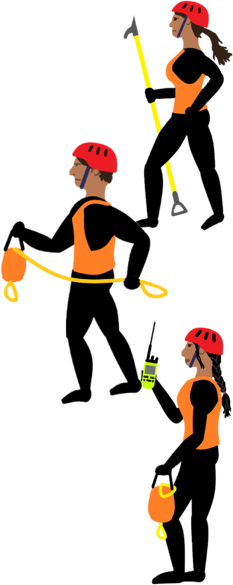
Rescue Team – Every situation is different but ideally this should be 2 or more rescuers directly working to pull people out of the water. They should be starting with the simple methods first and progressing toward more technical. |
|
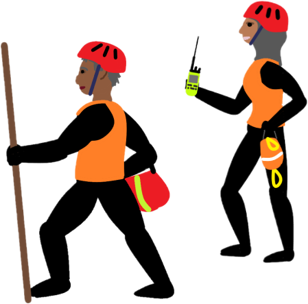
Downstream Safety – One rescuer, ideally more than one, should go downstream of the incident and be prepared to pull out anyone who falls into the water. The downstream safety should be ready to take over as the rescue team should the victims get past the first rescue team. |

|
Support and Command – At water rescue scenes, not everyone should be at the water. Rescuers providing logistical and medical support often need to be ready to shuttle equipment and people around as needed. If everyone is standing on the river bank, there is no one to grab critical equipment from the truck. How do we look around to see what needs to be done? How do we communicate what we are doing with others? Leadership should consider how they will manage all the teams working together. Leaders caught up in making the rescue themselves are no longer leading. Just as rivers flow and change, expect water incidents to be dynamic. Be ready to adjust. |
How do you communicate changes in a caring effective manner?
Conclusion
Working with many people spread out along the water doing different tasks can be challenging. Most emergency rescues can not be done by a lone person and are best executed by teams who have practiced together. I use the term ‘team’ loosely to refer to whatever group attempts to rescue those in danger, be it a rafting group or a dedicated emergency response unit. Whatever group finds themselves at the water rescue scene can divide into upstream spotters, rescuers, and downstream safeties. But remember a successful rescue is where all the rescuers go home safely after doing their best.
Thank you to Christine Lustik for helping proof read my confusing words, K. Kunsirilanchakorn Kongpok for helping translate into Thai.
References
Kauffman, R. B. (2018). Swiftwater Rescue Course Manual. McHenry, Maryland: Garrett College.
Phillips, K. (2012). National Park Service Swift Water Rescue Manual. United States Department of the Interior, National Park Service.
Royal National Lifeboat Institution. (2017). Flood Rescue Manual. Dorset, England: Royal National Lifeboat Institution.